

Buying backlinks safely in 2026 is not about finding a vendor that says its links are “white-hat” and “100% safe”.
It is about understanding what you are actually buying.
Most companies waste money because they buy link inventory. They choose from whatever domains a vendor already has in a spreadsheet, marketplace, or recycled guest post network. That usually means the same guest post farms everyone else can access.
A safer off-page SEO approach starts with the pages you want to grow, the queries you want to compete for, and the websites already ranking around those topics. Then you acquire links from pages where the mention makes sense for the reader.
This guide is based on my 5+ years of link building experience and what I’ve personally seen in the SaaS backlink market: recycled vendor lists, overpriced guest posts, low-traffic niche edits, and placements that look good in reports but do nothing for rankings, leads, or AI visibility.
Yes, you can buy backlinks safely when you prioritize providers that use manual outreach and build links on pages with real traffic, natural context, and a clear reason to mention your product.
The safest approach is SERP-driven. Start with the queries your target page needs to rank for, find the topical cluster of pages already ranking for those topics, and acquire links where your mention naturally fits the context.
This is different from buying links from marketplaces, spreadsheets, or recycled guest post networks. Those sources usually give you access to the same sites everyone else can buy from, which makes the placements less valuable and easier to devalue over time.
Google still treats links built to manipulate rankings as link spam, and paid links are technically supposed to use attributes like rel="sponsored" or rel="nofollow".
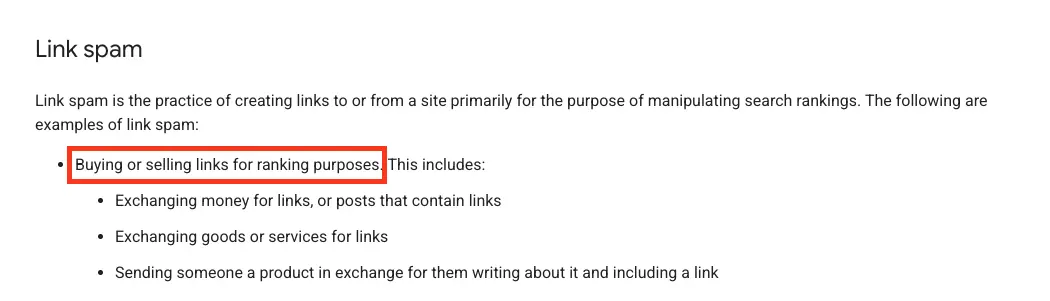
That creates an unavoidable distinction between what Google officially permits and how the backlink market operates in practice.
But the practical question is not whether companies buy backlinks. In an Editorial Link survey, 91.9% of SEO professionals said they believed their competitors were buying links.
The real question is whether the link comes from a relevant page that can pass value, support rankings, and make sense for the reader.
So yes, backlinks can be bought safely. But safety comes from the acquisition process: research, outreach, filtering, editorial fit, and monitoring.
Most companies waste money buying links because they look for quick shortcuts and end up buying whatever vendors already have available.
The weakest placements usually are not so easy to catch. They are the “looks okay in Ahrefs” domains where the domain ranks for spammy keywords, exact page has no traffic, the article is unrelated, or the site sells placements across every niche
That usually leads to three problems:
Many link vendors sell placements from the same domains again and again. These sites often look fine at first glance because they have DR, traffic, and indexed pages.
But once you check deeper, many are just guest post farms selling links to every niche. Their traffic often comes from irrelevant or manipulated keywords like net worth queries, quote pages, random number searches, or other topics that have nothing to do with your industry.
The link may go live, but it usually doesn’t pass any meaningful value because modern search algorithms often simply ignore such links.
A domain can look decent, but the page itself may have no traffic, no topical value, and no real reason to mention your product.
This is common with niche edits placed inside old articles that no one visits anymore. The domain metric looks good in a report, but the actual placement adds almost nothing.
The exact page matters more than the domain metric.
Many companies build links to blog posts because they are easier to place. But those pages often do not convert well.
For SaaS companies, the better targets are usually product pages, feature pages, comparison pages, alternative pages, and other bottom of the funnel pages that can turn search visibility into leads.
A link is only useful if it supports a page that can create business value.
The biggest backlink risk is often not a penalty. It is spending money on placements that create no measurable value.
Buying link inventory or paying for manual link acquisition are two very different ways to buy backlinks.
Buying link inventory means choosing from websites a vendor already has available. This is how most marketplaces, spreadsheet sellers, guest post vendors, and low-quality niche edit providers work.
Manual link acquisition starts with your target page and the topics it needs authority for. The provider researches relevant SERPs, qualifies the ranking pages, and acquires placements where your link adds useful context.
For SaaS and B2B companies, manual outreach agencies are usually the safest option because they can find relevant pages that already rank around your topic.
For aggressive niches like iGaming, CBD, or churn-and-burn affiliate SEO, resellers and marketplaces are more common because clean editorial placements are harder to secure.
The main thing to understand is simple:
Inventory sellers primarily sell access. Manual acquisition providers sell research, qualification, outreach, negotiation, and placement.
The safest way to buy backlinks is to start with strategy. Choose the page you want to grow, pick a link building acquisition method that works the best for that page, and acquire links from relevant pages where your mention actually makes sense.
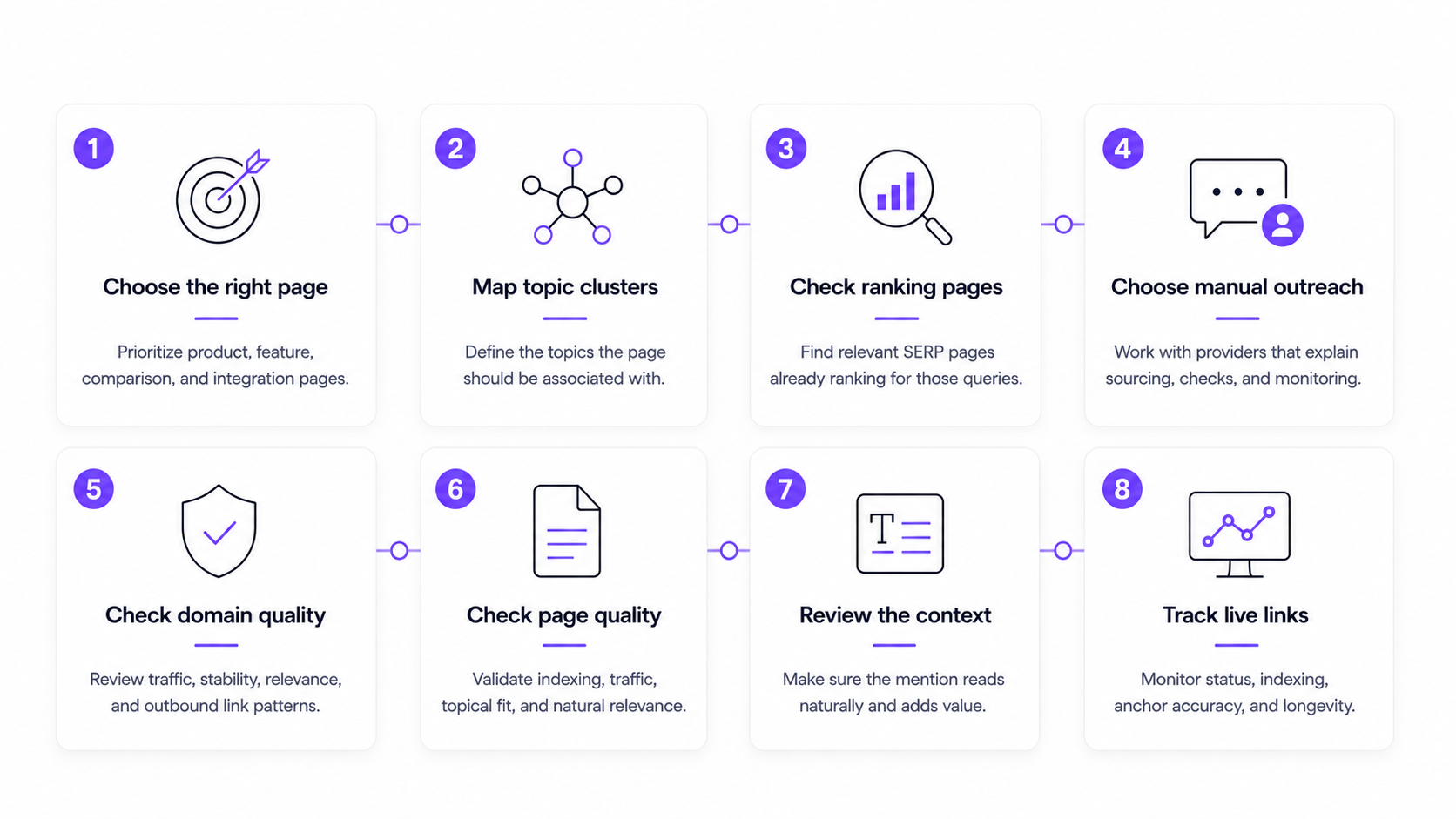
Start by choosing the page that deserves links.
For SaaS companies, this usually means product pages, feature pages, comparison pages, alternative pages, integration pages, or other pages that can convert traffic into leads.
Blog posts are easier to build links to, but they are not always the best targets. If a page cannot support the buyer journey, buying links to it is usually a waste of budget.
Do not start by asking, “Which domains can I buy links from?”
Start by asking, “Which topics does this page need to be associated with?”
Your backlink opportunities should come from pages that already sit inside those topics. This keeps the campaign focused on topical relevance instead of random domain metrics.
Once you know the topic, check the SERPs.
Look for pages already ranking for relevant queries. These can be comparison articles, software roundups, guides, tutorials, alternatives pages, resource pages, or industry blogs.
These pages are usually better opportunities than random domains from a vendor list because they already have topical relevance, search visibility, and a reason to mention your product.
Prioritize providers that can clearly explain how they find websites, qualify pages, and secure placements.
A good provider should be able to explain:
At saaslinkbuilder, we start with the target URL, map relevant outreach topics, then check top ranking pages in the SERPs, and run manual outreach to secure placements where the mention naturally fits.
Avoid providers that only send a spreadsheet of domains and ask you to choose links based on DR, traffic, and price. If you're comparing providers, this comparison of SaaS link building agencies breaks down different agencies based on SaaS specialization, sourcing methods, relevance, and their approach to Google and AI visibility.
Before placing a link, check the domain beyond surface-level metrics.
Look at:
A website can have good DR and still be a bad placement if its traffic comes from irrelevant keywords or it sells links across every niche.
In our campaigns, we treat page-level relevance and visibility as stronger qualification signals than DR alone. DR can help with initial filtering, but it cannot tell you whether the exact article ranks and receives traffic.
Check whether the page:
Domain metrics describe the website. Page-level traffic, relevance, and context determine the quality of the actual placement.
The link should read naturally inside the article.
The sentence around the link should explain why your product, service, or content is being mentioned. It should add context for the reader, not look like a random keyword inserted into a paragraph.
If the placement feels forced, it is probably not a good link.
Safe backlink buying does not end when the link is published.
Track whether the link stays live, stays indexed, keeps the right anchor, and remains on a page that still makes sense.
Ahrefs found that at least 66.5% of links to sampled websites became dead over a nine-year period. That does not mean every backlink campaign loses links quickly, but it does show why link monitoring and replacement policies are part of safe backlink buying, not a bonus.
At saaslinkbuilder, we provide unlimited link monitoring and a 12-month replacement guarantee, so clients are not left paying for links that disappear or stop meeting basic quality standards.
A cheap link that disappears after a few months is not cheap. It is a wasted budget.
A safe backlink usually costs €300–€500 for SaaS companies.
Anything below €200 is often suspicious because proper manual outreach, quality checks, content, and monitoring are hard to deliver at that price. Anything far above €500 needs a clear reason, such as a ranking listicle placement or strong referral potential.
Cheap links are usually cheap for a reason. Vendors often cut corners on prospecting, content quality, page relevance, or monitoring.
Expensive links are not automatically better either. A €700 link on a generic guest post farm is still a bad link.
Backlink price should reflect acquisition difficulty and placement quality, not just the DR of the domain.
The biggest red flag before buying backlinks is a provider that cannot explain how the link will be sourced, why the page is relevant, and what quality checks are done before placement.
Insight from Jayson DeMers, Founder of EmailAnalytics
“Watch for red flags like sites with excessive outbound links, irrelevant content, guaranteed rankings, lack of transparency, and unnatural anchor text ratios.”
Use this checklist before buying or placing a backlink:
At saaslinkbuilder, these checks are part of the link qualification process. We start with the target URL, review topical and SERP relevance, check domain and page quality, evaluate placement context, and monitor links after they go live with unlimited monitoring and a 12-month replacement guarantee.
Buying low-quality links is more likely to waste money than instantly penalize your site.
Modern search algorithms can ignore or devalue spammy links instead of rewarding them. If bad links could easily penalize a website, competitors could use them for negative SEO. The bigger risk is paying for links that do not pass meaningful value.
Usually, not that much.
Many “toxic link” reports overstate the risk of random spammy backlinks. You should focus more on whether the links you intentionally build come from relevant pages with real traffic, natural context, and clean outbound link patterns.
The safest way is SERP-driven manual acquisition.
Start with the page you want to grow, identify the topics and queries it needs authority for, find pages already ranking around those topics, and secure placements where your mention naturally fits.
Marketplace backlinks can work in some niches, but they require heavy filtering.
The main issue is that many marketplace sites sell placements openly to anyone. If the same domain is available to every buyer in every niche, the link is usually less valuable and more likely to be ignored or devalued.
You can buy backlinks with lower practical risk, but only when you treat the process as link acquisition rather than link shopping.
Start with a target page that deserves to grow. Find relevant pages where your inclusion genuinely fits. Evaluate the exact placement rather than relying on DR alone, and pay for research, relevance, editorial context, and ongoing quality control rather than access to recycled inventory.
The objective is not to eliminate every possible risk. It is to make better decisions before the link goes live and to avoid paying for placements that provide no value.

Article by
Mykolas is the founder of saaslinkbuilder and has built over 5,000 high-quality links for SaaS companies. He got his start working with top Lithuanian SaaS brands and now shares insights on link building, content marketing, and SEO.

Book a Free Consultation

saaslinkbuilder is a SaaS link building agency for Google & AI visibility
Copyright 2026 - saaslinkbuilder
